Why Customer Surveys Fail and How Voice-based Forms are Fixing it
You sent the survey. Fourteen people out of five hundred responded. Eleven of them gave you five stars without reading the questions. This is not feedback. This is noise.
Customer surveys have been a staple of business feedback collection for decades. They are familiar. They are easy to deploy. They generate numbers that can be put into charts. And they fail, systematically, at the thing they are supposed to do: give businesses an accurate understanding of how their customers actually feel.
The problem is not with the idea of collecting feedback. The problem is with the method. Text based surveys were designed for a world where customers were comfortable navigating digital forms, reading questions carefully, and typing out responses. That world does not reflect the reality of most businesses , especially in markets like Nepal.
Why Traditional Surveys Fail
Completion Rates Are Low
Industry data on survey completion rates is consistent across sectors: the average completion rate for a customer satisfaction survey sent after an interaction is between 10% and 30%. In most cases, the customers who respond are the ones who had either an exceptionally good or exceptionally bad experience. The silent majority, who had an ordinary experience, do not bother.
This creates a systematic bias in the data. The feedback organizations are basing decisions on does not represent their typical customer. It represents their most emotionally engaged ones.
Text Inputs Lose Nuance
Even when customers do complete a survey, the format of most surveys limits what they can express. Rating scales reduce complex feelings to a number. Multiple choice options force customers to choose the closest approximation to what they actually think. Open text boxes are intimidating, particularly when typing in a second language or on a mobile keyboard.
The result is survey data that is shallow. It tells businesses what customers chose from a list of options. It does not tell them what customers actually wanted to say.
Language Is a Barrier
In Nepal, a significant proportion of customers are more comfortable expressing themselves in Nepali than in English. Most digital survey tools default to English or Roman script. Customers who would have valuable feedback to share, about a product experience, a service interaction, a complaint, do not share it because the medium does not match the way they naturally communicate.
Asking a Nepali-speaking customer to type out their feedback in English is not collecting feedback. It is creating friction and then blaming the customer for not providing it.
What Voice-based Forms Change
Voice-based forms allow customers to give feedback the way people have always communicated most naturally, by speaking. Instead of navigating a digital form and typing responses, customers are called or prompted to speak their feedback. The AI listens and converts spoken Nepali into organized, structured, actionable data.
The practical difference in completion rate and data quality is significant. Speaking is faster and lower effort than typing. It removes the language barrier. It captures tone, emotion, and nuance that text cannot. And it meets customers where they actually are: on their phone, communicating the way they do in every other context.
How TingTing Forms Works
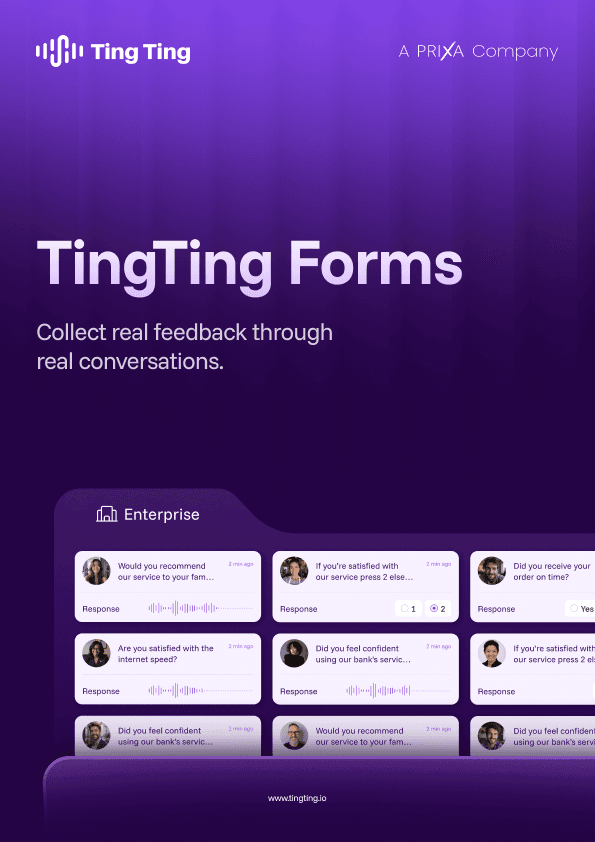
TingTing Forms is TingTing's voice-powered data collection product. Instead of sending a text-based survey, businesses use TingTing Forms to initiate a voice interaction through a call, where the customer speaks their response in Nepali.
The AI processes the spoken input in real time, and transcribes the voice response, storing it as both the audio and it's transcription. A customer who says "The delivery was fine but the packaging was damaged and I had to wait longer than expected" does not generate a vague open-text response. The system captures the exact tone and emotion through their voice.
The result is feedback that is richer, more representative, and more actionable than anything a text survey typically generates.
What Businesses Can Do With Better Feedback
The value of accurate feedback data is not in the data itself, it is in the decisions it enables. When a business knows that 40% of customers who gave voice feedback mentioned packaging issues, it can investigate and fix the packaging process. When sentiment reveals that customers are consistently frustrated at a specific point in the service journey, it can address that point directly.
Text surveys give you numbers. Voice forms give you understanding. And understanding is what actually drives improvement.