Chatbots vs. AI Agents: What Nepali Businesses Actually Need
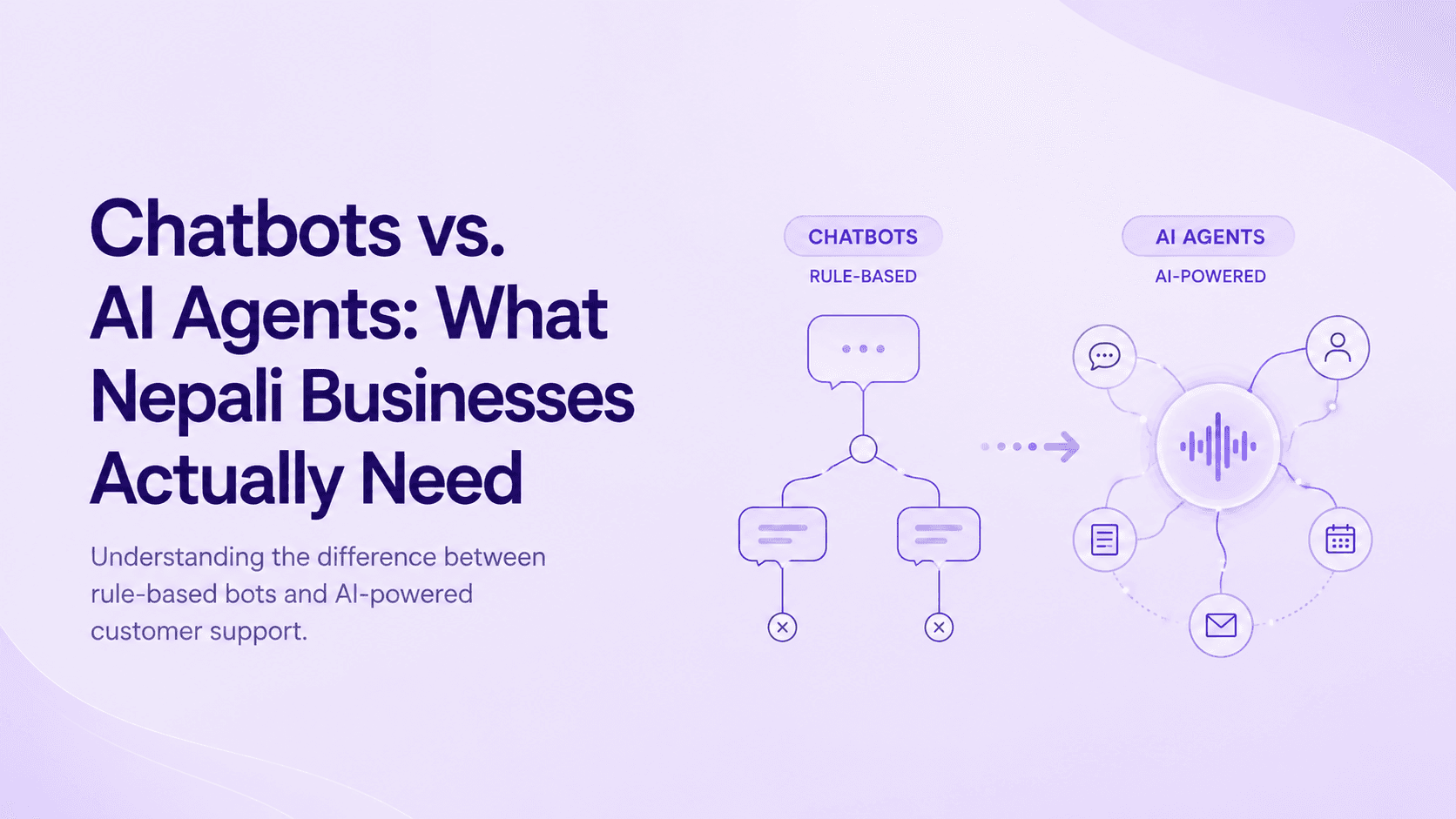
If you ever run a service based business in Nepal - Bank branch, a hospital, a cooperative, an e-commerce store the chances are you've already experimented with a chatbot. And chances are it didn't go well.
Someone types "loan ko lagi ke chahincha?" and gets a canned response about store hours. A customer asks two questions in one message and the bot only answers the first. Frustrated, they hang up the chat window, call your office instead, and your staff end up handling the exact repetitive query the bot was supposed to take off their plate.
This isn't a Nepal specific problem, but it does hit local businesses harder because most off-the-shelf chatbot tools are built for English, built for typing, and built around rigid decision trees that don't bend well around how Nepali customers actually ask questions: in Nepali, in Romanized Nepali, over the phone, mixing languages mid-sentence, and rarely in the exact keywords the bot was trained on.
So is an AI agent really different from a standard chatbot, or is it just a fancier name for the same frustrating experience? The difference is real, and understanding it can save your business a lot of missed calls and annoyed customers.
The old chatbot: a decision tree pretending to be a conversation
Most "simple" chatbots, the kind integrated onto a website or Facebook page a few years ago, aren't really intelligent. They're decision trees. Somewhere behind the chat bubble is a flowchart: if the customer types A, show response B; if they click this button, show that menu.
This works fine for one thing: routing. It falls apart the moment a real customer shows up, because real customers don't think in flowcharts. They:
- Ask multiple things in a single message ("what's my account balance and can I also update my phone number")
- Phrase the same question in ten different ways
- Speak or type in Nepali, English, or a mix of both
- Expect the conversation to remember what they just said
A rule based bot has no understanding of intent the only pattern matching against a limited set of phrases. Miss the pattern, and the customer hits a dead end: "Sorry, I didn't understand that." That's the exact moment trust in the bot breaks, and the customer either gives up or calls your office anyway which defeats the purpose of having the bot at all.
The AI agent: something closer to a capable employee
An AI agent works on a completely different principle. Instead of matching keywords to pre-written scripts, it's built on a language model that actually understands intent and what the customer is trying to accomplish and pulls the answer from your organization's actual knowledge base: your FAQs, policies, product details, and processes.
Practically, that means an AI agent can:
- Understand natural language, including Nepali and Romanized Nepali, without the customer needing to phrase things a specific way
- Handle several questions in one interaction, the way a human staff member would, rather than resetting after each answer
- Recognize when it doesn't know the answer, and hand the conversation off to a real person instead of guessing or looping
- Work around the clock, picking up calls or messages at 11 PM on a Saturday just as reliably as at 11 AM on a Monday
- Handle many customers simultaneously, so no one is stuck in a queue because everyone else called at the same time
That last point matters more than it might seem for a growing business. A rule based chatbot doesn't reduce your team's workload much, because it can only manage the simplest queries before escalating.
An AI agent takes on the bulk of the genuinely repetitive work like account questions, appointment status, KYC steps, return policies, interest rates and only brings your staff in when a query truly needs a human judgment call.
Why this distinction matters for service businesses in Nepal
Banks, healthcare providers, cooperatives, government offices, and e-commerce businesses in Nepal all share one thing in common: a high volume of repetitive inbound calls and messages. Someone checking on a claim status. Someone asking about account registration. Someone wanting to confirm an appointment or a return policy.
None of these questions are complicated. But answering the same question hundreds of times a day, every day, is exactly the kind of work that burns out support teams and creates long call queues which is often where customer trust is lost first, before the actual service is ever delivered.
This is the gap TingTing Agents is built for. Rather than forcing customers through a rigid menu tree, TingTing Agents answers inbound calls in natural Nepali, resolves routine questions directly from your organization's knowledge base, and automatically escalates to a human agent the moment a query goes beyond what it can confidently answer. It handles unlimited concurrent calls, so there's no queue during busy hours, and it runs 24/7 including outside your office hours, when a customer's question can't wait until morning.
Organizations already using it for exactly this kind of high volume, repetitive inbound support include financial institutions handling KYC and loan queries, healthcare providers managing appointment and claim questions, and retail and e-commerce businesses fielding return and order status calls.
What this means if you're evaluating options
If you're a Nepali business owner weighing whether to invest in a chatbot or an AI agent, the real question to ask isn't "can it answer FAQs", most tools can do that at a basic level. The better questions are:
- Does it actually understand Nepali the way your customers speak it and not just typed keywords, but natural, spoken language?
- Can it handle more than one question per conversation, or does it reset and frustrate the customer after every exchange?
- Does it know when to hand off to a human, or does it trap customers in a loop when it hits its limits?
- Can it scale during your busiest hours without customers sitting in a queue?
A rule based chatbot will struggle with all four. A properly built AI agent which is trained on your organization's own knowledge base is designed to handle them by default.
The goal isn't to replace your team. It's to make sure the same five questions don't eat up their entire day, so they can focus on the calls that genuinely need a human touch.
If you are curious what this looks like for your business?
Book a free demo of TingTing Agents and see how it handles a real customer call in Nepali without needing technical setup.