AI Telephony in Nepal: The Future of Voice Communication
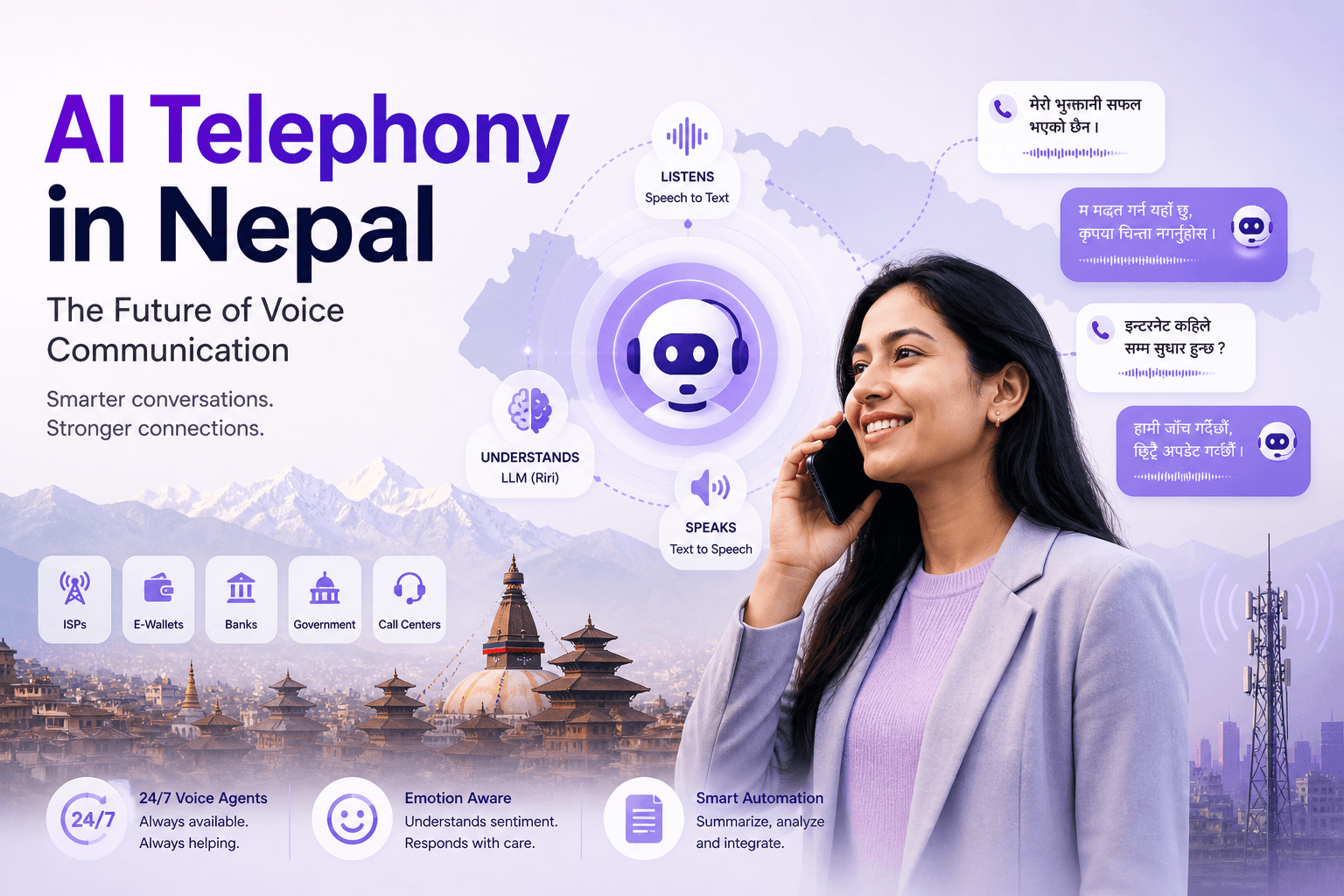
AI Telephony and why Nepali businesses are trusting and integrating it in their own Software.
Why is there a need for AI Telephony in Nepal ??
When you are watching the World Cup, Champions League or even if you are browsing through social media or even when you are doing payment through eSewa or Khalti, and you encounter internet lag or payment error then you call them. Surprise, you encounter “press 1 for English”, “press 2 for Nepali”, then some ringing sound and no response, gone like a ghost.
It’s so frustrating. But lately, tech in Nepal is changing. You might have noticed when calling ISPs and e-wallets, they respond with clarity and perfect voice which can even convince us of the inconvenience they have caused.
And that’s not always a human answering you. It’s AI telephony.
What actually is AI telephony ?
AI telephony is the integration of AI with traditional call, evolving the communication that listens, understands and talks back while preserving the sentiment or human tone and emotions. This helps in automating calls while using Natural Human Language.
This is a three step process that happens in sub 200 millisecond and that’s fast;
1. Initially it listens your voice in Nepali and turns it into text and that’s speech to text ( STT )
2. Next it understands your sentiment even when you are just frustrated, complaining about a failed payment or asking about the price of ISPs. That’s how LLMs for Nepali voice are trained and are called “Riri”.
3. Finally it speaks with emotion in Nepali voice and that’s text to speech ( TTS )
Currently in Nepal, technology is shifting from “robotic” or “AI” voices to voices like “Riri” (from TingTing), which is natural native Nepali voice built specifically to sound like a real person from Kathmandu or Pokhara or your brother, sister, mother or anyone you interact with.
Current Nepali AI telephony is mostly "Informational" (FAQs). Like just answering pre recorded questions.
This is an effort to modernize customer service and handle heavy daily traffic, as many customers are asking the same questions again and again.
Which tasks are best suited or benefit from AI telephony?
Beyond just talking and answering pre-recorded answers to customers, AI telephony platforms like TingTing generally perform a few high level functions:
● 24/7 Voice Agents: This software acts as a customer service person, but capable of handling hundreds of calls simultaneously without putting anyone on hold while delivering flawlessly.
● Sentiment Analysis: Some system like TingTing connect can detect a caller's tone or their sentiment. If a caller is getting frustrated or angry, this system can instantly flag the call and answer with convincing emotion.
● Call Summarization or Survey: After any call ends, the AI instantly writes a summary, logs it into a CRM and provides detailed and analyzed information based on the survey. But a significant "Trust Accuracy" gap remains un-answered among consumers or your clients. While businesses see 60-70% cost savings, the public remains skeptical about the AI's ability to handle complex emotional complaints as per our gathered data.
Who is adopting AI telephony in Nepal ?
● Public Sector like Nepal Telecom (NTC) deployed "Maina," an AI agent answering 600+ FAQs to reduce physical office congestion.
● Private sectors like WorldLink, Vianet, eSewa, and Citizens Bank have replaced traditional IVRs with AI agents ( TingTing ) to handle up to 20,000 concurrent calls.
● Banking and Finance (BFSI): AI telephony is being integrated with broader automation to handle KYC processes, account balance inquiries, and loan information dynamically.
● Call Center Automation: Businesses are replacing offshore or heavily staffed 24/7 call centers with AI agents that never sleep and can handle thousands of concurrent calls without busy signals.
● Government : Even government bodies are integrating AI telephony in times like natural disasters, important public announcements and the current government is even planning to integrate with transport management to notify of license printing, passport, NID and other mass texting announcements.
So Who is providing AI Telephony service in Nepal ?
The most trusted platform in Nepal for AI telephony service is tingting. "Tingting Agents" enable two-way, emotion aware conversations with sub 200 millisecond response times.
So TingTing has become an AI Voice Agent Platform for Phone Call Automation which is trusted by ISPs, government and even e-wallets like eSewa. TingTing has bridged the gap and helped in automating Call centres, customer support and made AI powered human agents for telephony.
The next evolution for Nepal's AI telephony isn't just "better voices," but "tighter integrations", moving from an AI that "talks" to an AI that "works" within the local business ecosystem and can connect with people by reducing the robust tasks. The closest to this achievement is TingTing, an AI powered Business Communication suite