How Much Money Can an AI Support Agent Save Your Company?
Every business owner who has looked into AI support eventually asks the same question, and it's usually not "does it work?" It's "does it actually satisfy my customers?"
This is a fair question, Nepali businesses have tight margins, and "innovative technology" has a track record of sounding exciting in a sales pitch and then quietly becoming another thrown out item nobody even uses later on. So instead of talking in vague terms about "efficiency" and "transformation," let's actually break down where the real money goes in a support operation today, and where an AI agent changes your finances.
The Real Cost of Running Inbound Support the Traditional Way
Before you can measure costing in customer support, you need to see the full cost of what you're already paying for.
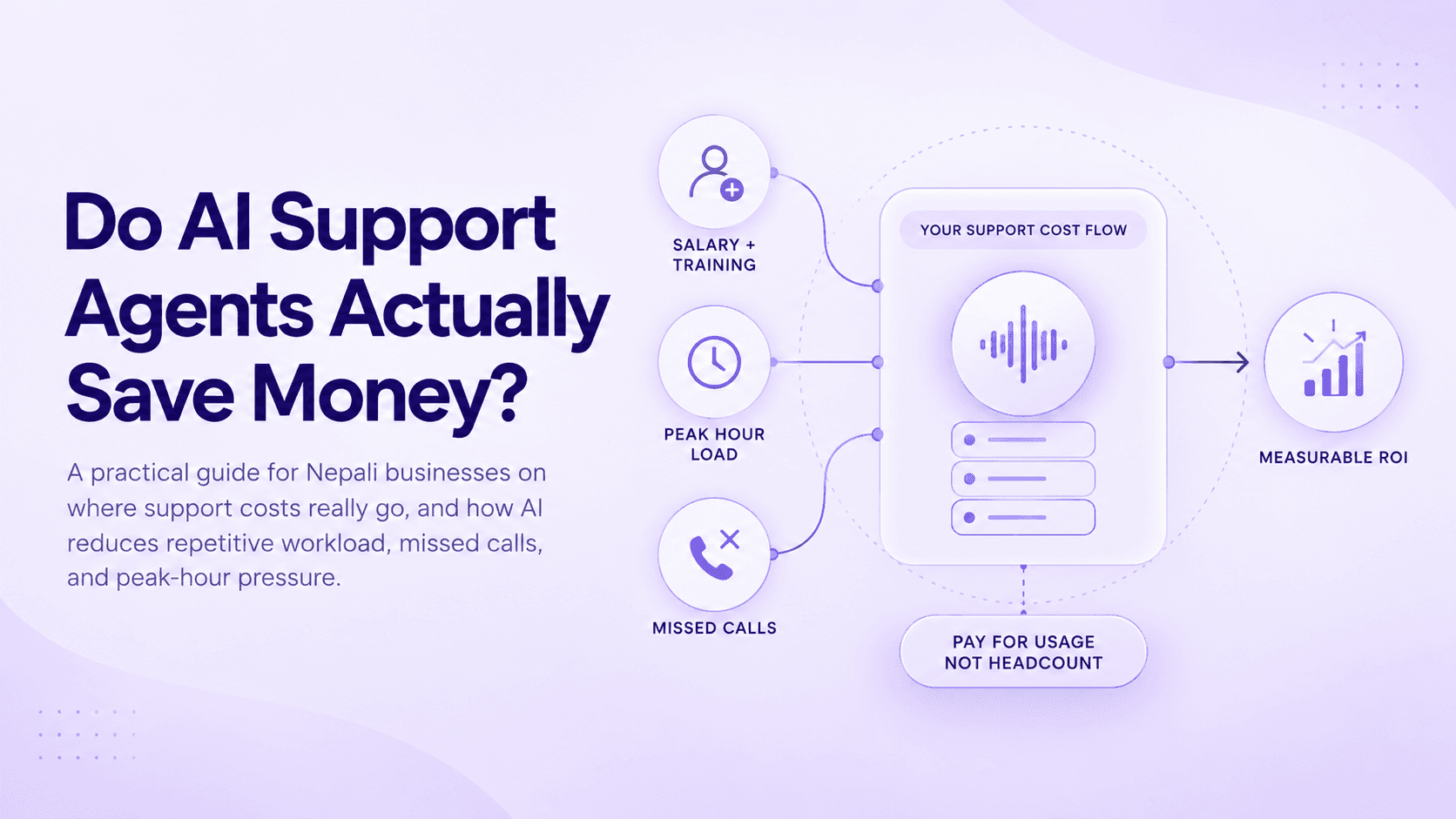
Salary Is Just the Starting Point
A support agent's monthly salary is the visible cost. The hidden costs sit around it: recruitment and training time before they're productive, supervisor time spent managing and correcting them, benefits and leave, and the inevitable turnover, because inbound support, answering the same questions all day, is one of the highest turnover jobs in any company, people gets detained easily when interacting with clients or customers. Every time someone leaves, you're paying to train their replacement from zero, just another repetitive work.
Peak Hours Force You to Overstaff or Under serve
Most support teams are sized for average call volume, not peak volume. That means during a festival sale, a service outage, or an election period, you're either paying overtime and temporary staff to keep up, or customers are sitting in a queue getting frustrated and a frustrated customer on hold is a customer who's one bad experience away from leaving.
The Cost You Can't See on a Spreadsheet: Missed Calls
This is the one thing most businesses underestimate. Every call that goes unanswered outside office hours, or every caller who hangs up after five minutes on hold, is a potential transaction, complaint, is a risk that never gets mentioned anywhere. You don't see this cost on a monthly P&L, you just see it later, as lower repeat business, without ever tracing it back to the missed call.
Where AI Support Agents Change the Cost Structure
An AI voice agent doesn't eliminate your support team and it absolutely shouldn't, because sensitive or complex conversations still need a human. What it does is absorb the repetitive layer of inbound volume that's currently consuming most of your team's day and energy, and it changes how that cost scales.
You Pay for Usage, Not for Headcount
Traditional support cost scales with people: more call volume eventually means more hires, more desks, more training cycles. TingTing Agents runs on a credit based model instead you pay based on actual call usage, not a fixed monthly headcount cost that keeps running whether call volume is high or low that week. That alone reduces your finance from fixed cost to usage-based cost and it is often the biggest factor in the ROI conversation, because it means your support cost tracks your actual demand instead of your worst case staffing plan.
No Overtime for After Hours or Peak Season Demand
Because TingTing Agents operate 24/7 by default, a spike in calls during Dashain Tihar sales, an exam result day, or a service disruption doesn't require emergency overtime pay or temporary hires. The AI agent handles unlimited concurrent calls, so there's no wait queue driving customers to hang up and call a competitor instead.
Training Time Drops From Weeks to a Knowledge Base Upload
Onboarding a new human support agent typically takes weeks of guidance and correction before they're handling calls independently. An AI agent is trained directly on your existing FAQs, policies, and knowledge base so no call tree design, no lengthy technical setup. That's a direct, measurable reduction in training overhead every time your policies change or your team scales.
Escalation Data Turns Into a Cost Cutting Tool
Every call TingTing Agents handles is logged with full analytics, what customers actually asked, what got resolved automatically, and what needed a human.
That data alone has financial value: it shows you exactly where your remaining human support hours are going, and it usually reveals just how much of your team's time was going toward questions that never needed a human to answer at all.
A Simple Way to Think About the ROI
You don't need a complicated model to see whether AI support pays for itself. Ask three questions about your current support operation:
- What percentage of your inbound calls are genuinely repetitive? Account queries, order status, appointment confirmations, policy questions versus calls that truly need human judgment?
- What does an hour of missed or delayed support currently cost you in lost transactions, refund complaints, or customers who simply don't call back?
- How much do you currently spend on overtime, temporary staffing, or overflow support during your predictable peak periods?
For most service businesses like banks, healthcare providers, retail, cooperatives, government offices, the first number tends to be surprisingly high, often the majority of total call volume. That's the portion an AI agent is built to absorb, freeing your paid human hours for the calls that actually need them.
The Things to Finalize the Thoughts
The financial case for an AI support agent isn't about replacing your current team, it's about not paying human hour costs for questions that don't require a human. Once you stop overstaffing for repetitive queries, you stop losing after hours of calls, and stop burning weeks of training time every time someone joins or leaves your support team, the savings show up in places you were already paying for and just not efficiently.
If you want to see what that actually looks like against your own call volume, the fastest way to find out is to run the numbers on a real conversation.
If you are curious what this could save your business?
Book a free demo of TingTing Agents and get a usage estimate based on your actual call volume, not just random guesses.