How to Add AI Customer Support to Your Website Without Losing the Human Touch
There's a quiet worry a lot of Nepali business owners have about AI customer support, and it usually doesn't get said out loud in sales meetings also:
“Will this make my business feel colder? Will customers feel like they're talking to a wall?”
“Will this feature help me gain customer trust and sales?”
It's a fair question to ask. Customer service here has never been purely transactional, a loan officer who remembers your name, a hospital receptionist who understands why you're anxious, a shop owner who takes time to explain something twice. That personal thread is part of how trust gets built, and no business wants to trade it away for automation.
The good news is that you don't have to compromise. A well implemented AI agent isn't designed to replace that human connection, it's designed to protect your team's time so they can spend it on the calls that are worth and where that connection actually matters, instead of burning out on the repeated question like; "what are your business hours" call of the day.
Let's walk you through how implementation actually works, and exactly how the handoff to a human happens when it's really needed.
How Do I Implement an AI Support Agent? A Realistic Setup Process
One of the biggest misconceptions about AI customer support is that it requires a complicated technical rollout, new servers, a development team and months of integration work. That's true for some enterprise systems. It isn't how it has to work for companies like TingTing.
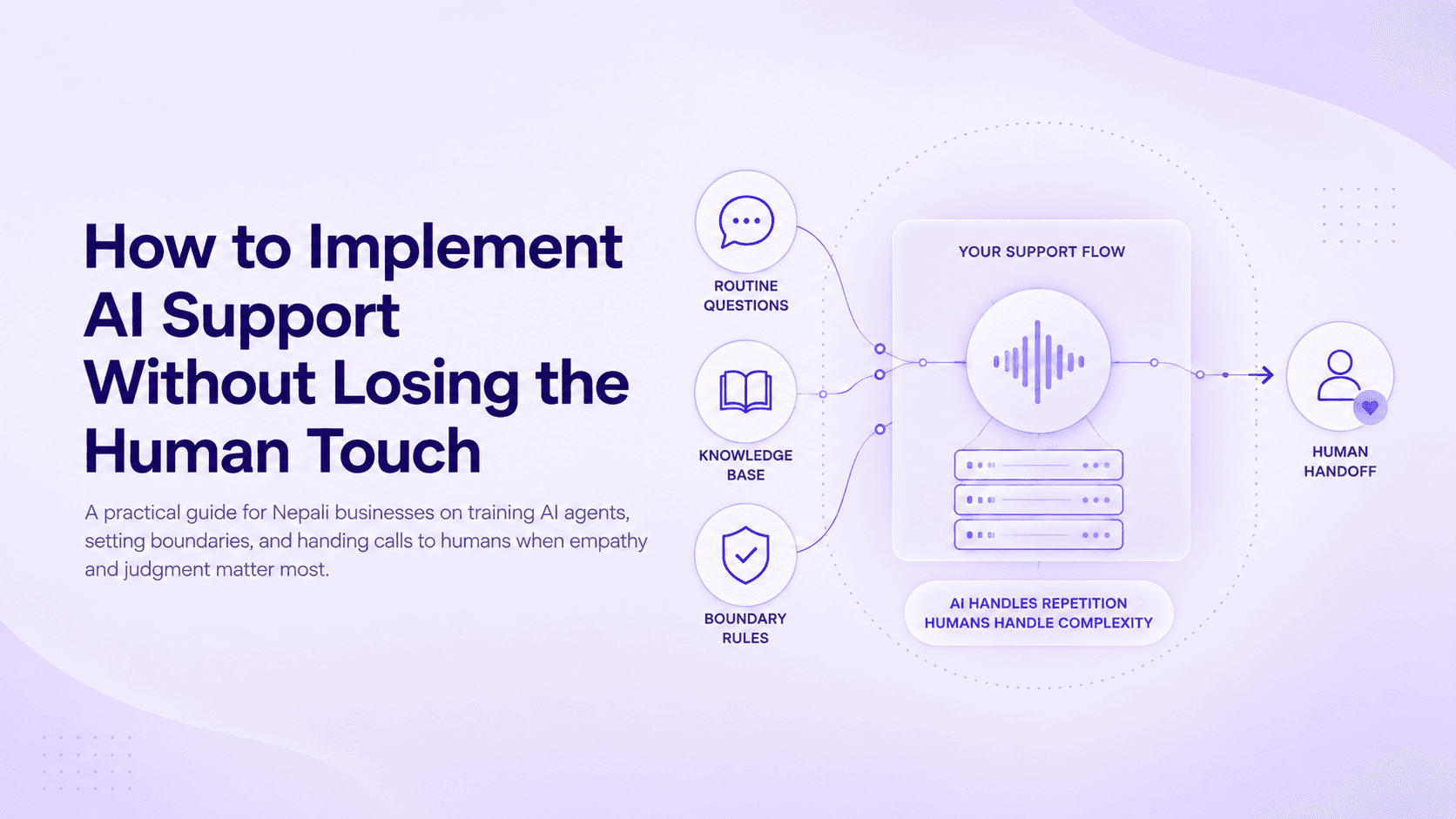
Step 1: Identify "Repetition" in Your Business Questions
Before any AI agent goes live, the real starting point is figuring out which questions genuinely repeat. For most service businesses, this is a shorter list than you'd expect: account status, appointment booking, return policies, loan terms, KYC steps, order tracking. These are the questions your team answers dozens of times a day without even needing any real judgment call.
Step 2: Train the Agent on Your Existing Knowledge Base
This is the part people are usually most surprised about, there's no complex calls or scripting language to learn. TingTing Agents is trained directly on your organization's own FAQs and policies. You're not building a robot from scratch; you're teaching it what your front desk or support team already knows and telling them to answer the question.
Step 3: Set the AI Boundary Rules
This is the step that actually protects the human touch, and it's worth understanding clearly: before the AI agent ever takes a live call, you define what counts as "beyond its scope." Anything outside your FAQ's confidence threshold like a complaint, a sensitive account issue, an unusual request should get automatically routed to a human agent instead of the AI attempting to guess an answer to preserve the confidentiality.
Step 4: Go Live, Without the Heavy Technical Lift
Because TingTing Agents and TingTing Connect are handled as guided onboarding rather than a self-serve technical setup, your team doesn't need in-house developers to launch. You work directly with TingTing's team to configure your knowledge base, boundary paths, and voice preferences, and the agent starts answering real inbound calls in natural native Nepali from there onwards.
How Does an AI Agent Hand Off to a Human Agent?
This is the question that actually determines whether AI support feels helpful or feels like a hassle and it's the part most rule-based chatbots get badly wrong. A rigid bot either traps the customer in a loop of "I didn't understand that," or dumps them into a generic queue where they have to repeat everything they already said.
The AI Knows the Edge of Its Own Knowledge
A properly built AI agent doesn't try to bluff its way through a question that it can't confidently and answer with proof. When a caller's question falls outside what the AI knowledge base covers or the AI's confidence in its answer is too low without the backing of data or proof, it doesn't guess. It recognizes the limit and initiates a handoff instead of risking a wrong answer that damages trust.
The Handoff Happens Mid-Conversation, Not After a Dead End
The transfer isn't random, it's a built-in part of the conversation flow. The moment the AI agent identifies that a caller needs a human, it transfers the call directly, so the customer isn't stuck listening to "please hold" with no explanation or, worse, getting disconnected and having to call back from scratch and eventually losing a potential customer.
Your Human Team Sees the Full Picture, Not a Blank Slate
This is where the handoff experience really separates itself from a typical chatbot escalation. Every call TingTing Agents handles is logged with full call details and analytics. Paired with TingTing Connect, TingTing's AI-native call center layer with real-time transcription and sentiment analysis, your human agents will not just pick up a transferred call cold. They can see the context of what was already discussed, instead of asking the customer to explain their problem for the second time in the same call. If you've ever been frustrated repeating yourself to a second support person, you already know why this matters in your business.
Every Conversation Gets Reviewed, Not Just a Sample
One underrated part of this system of TingTing: while a traditional call center typically reviews only a small fraction of calls for quality, an AI-native setup like TingTing Connect analyzes conversations at scale, including sentiment while giving you visibility into how every customer interaction actually went, not just the vague half forgotten answer.
Why This Approach Fits Nepali Customer Service Culture
The fear that AI support means impersonal support usually comes from experience with the wrong kind of automation and rigid menu trees that make customers feel unheard or robotic. A properly implemented AI agent does the opposite: it clears the repetitive noise out of the way so that when a customer genuinely needs a human, a sensitive question, a complaint, a complicated case; they reach one quickly, with full context already in hand, instead of waiting in a queue behind twenty people asking about business hours.
That's not less human. It's your human team's time being spent where it actually counts.
Getting Started
If you're considering AI support for your business, the implementation question isn't "can we afford the technical overhead and the cost", for most Nepali businesses, there isn't much overhead to begin with. The real question is which of your repetitive inbound questions you're ready to hand over first, and how you want the boundary path to work for everything else.
Want to see the handoff in action for free?
Book a free demo of TingTing Agents and walk through exactly how a call transfers from AI to your team actually happens.